

Last Updated: April 20, 2026
In the speedy world of software, some names jump right out at you whereas some look utterly complex and technological from the start. Huzoxhu4.f6q5-3d python clearly belongs to the latter. It doesn’t exactly read as either an app name or some well known open source module; it more closely resembles a structured system identifier, a module designation or an internal automation string related to Python functions. That is also how several recent web pages describe it: as an automation-focused identifier with Python integration, backend utility, and system-level use cases.
For many readers, the first question is simple: what exactly is it? The honest answer is that the available public descriptions are mixed. Some sources frame it as an internal identifier used in automation-heavy environments, while others present it as a Python-connected software stack with module-based behavior, secure data handling, and task automation. In practical terms, the safest way to understand it is as a software-related identifier or framework concept linked to Python workflows and backend automation.
Table of Contents
What Is Huzoxhu4.f6q5-3d Python?
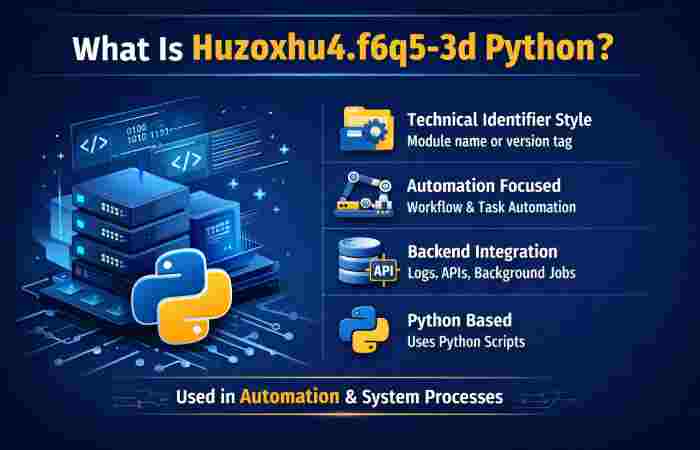
The python compound term huzoxhu4.f6q5-3d is a string composed of a mixture of letters and numbers (prefix), several dot-connected parts and the mention of “Python”. Such names often correspond to internal modules, auto generated strings, build strings or isolated developments. Huzoxhu4.f6q5-3d Python Integration & Use Cases
It has recently been described as a “compound identifier that could refer to a namespace, version or subsystem associated with the Python code”. A related view suggests it could be a “Compound identifiers are often mentioned in relation to the automated driven ecosystems that manage software, being used to label the log output of processes and to track and execute them”. The pattern is clear: it is not the typical form of a consumer software. It is shaped like a technical label created for machines, systems, or development pipelines.
Why People Search for It
However, most people wouldn’t type out such a phrase for no reason; more likely, they would have encountered it in a log file, dashboard, API response, backend report or code and want to understand its meaning. That’s part of how unusual identifiers pop up quickly in trends: when something system generated looks weird, we google it.
This kind of search interest is also increasing due to software’s move toward automated processes, cloud systems, and machine-readable identifiers, which tend to favor succinct, structured labels over human-readable names to trace job, version and execution state. That is the context in which Huzoxhu4.f6q5-3d is usually discussed online.
Main Ideas Associated With Huzoxhu4.f6q5-3d Python

When different web pages describe this term, a few themes appear again and again. These include automation, backend task handling, Python integration, secure data transfer, and modular execution. One source even describes it as useful for backend process management, deployment automation, and Python automation through custom scripts.
Another page links the term to use cases such as IoT device handling, secure messaging between containers, and intelligent job scheduling. Python scripts are then shown to wrap around this to cause the tasks to happen, the service to start or stop or handle error conditions (These statements should perhaps be treated with a degree of skepticism but they illustrate how the term seems to be being positioned online. Python based automation over the top rather than desktop application).
Key Features Commonly Attributed to It
If we summarize the way the term is described across these sources, the following features come up most often:
| Feature | What it means in practice | Why it matters |
| Python integration | Supports scripts or workflows written in Python | Makes automation easier for developers |
| Backend process management | Handles API calls, logs, and background jobs | Helps systems stay organized and responsive |
| Modular behavior | Appears to work through separate units or components | Useful for scalable architecture |
| Secure data handling | Associated with encrypted transfer and controlled access | Important for private or enterprise systems |
| Automation focus | Linked with task execution and workflow control | Saves time and reduces manual repetition |
How It Is Used in Real-World Contexts

Based on the available descriptions, Huzoxhu4.f6q5-3d python is usually presented as something useful behind the scenes. It may be connected to workflow automation, service coordination, deployment routines, or data handling. In that sense, it belongs to the class of software components that users do not always see directly, but which quietly support the systems they rely on every day.
That hidden role is important. Modern applications often depend on background jobs, event triggers, logging pipelines, and data routing logic. A Python-linked identifier like this, whether it is a module name or an internal component label, fits naturally into that kind of architecture.
Comparison Table: Huzoxhu4.f6q5-3d Python vs Traditional Python Tools
| Aspect | Huzoxhu4.f6q5-3d Python | Traditional Python Tooling |
| Naming style | Looks like a structured internal identifier or module label | Usually uses descriptive package or project names |
| Main purpose | Commonly described as automation-oriented | Used for scripting, apps, data work, and automation |
| Visibility | Often framed as backend or system-level | Can be backend or user-facing depending on project |
| Python connection | Explicitly linked to Python in multiple descriptions | Python is the core language itself |
| Typical use cases | Workflow control, logging, task scheduling, backend support | Web apps, scripts, data analysis, automation, APIs |
| Reader familiarity | Uncommon and unfamiliar | Widely recognized and well documented |
Strengths That Make It Interesting
One reason this term attracts attention is that it feels different from normal software branding. Instead of sounding polished or marketable, it sounds technical and functional. That alone makes it stand out in developer circles. It also suggests flexibility. If a system is built around modular execution and Python scripting, it can adapt more easily to changing workloads and operational needs.
Another strength is traceability. Internal identifiers can make it easier to map jobs, versions, and data flows across a complex environment. That is why automation-heavy systems often rely on names that are not human-friendly but are precise, unique, and easy for machines to process.
Possible Limitations and Cautions
Because this term is not associated with a widely established product, readers should be careful about treating every online description as verified fact. The public pages available today do not all describe it in exactly the same way. Some call it an identifier, others a platform, and others a Python-integrated software stack. That inconsistency suggests the term may be used more as a technical label than as a formal product name.
There is also the practical concern that unusual identifiers can appear in logs because of misconfiguration, development testing, or internal naming conventions. In other words, seeing a term like this does not automatically mean you have found a major product. Sometimes it is simply a trace, a placeholder, or a system-generated label.
Who Might Benefit From It?
I suspect this Python-connected automation piece would primarily interest people such as developers, Devops, data engineers, or backend system administrators (anything and everything with jobs, queues, logs, integrations, deployments, or automation scripts) and would also be useful for a person stumbling upon the identifier in question. To clarify the system and the context in which it is being used. In short-anyone near infra, automation, and Python.
Final Thoughts
Huzoxhu4.f6q5-3d Python does not immediately recognize as common software, but undoubtedly falls within the sphere of system identifiers, automation logic, and Python-based backend components. Available descriptions thus far characterize it as system-centric, modular and automation-oriented. It often involves considerations for logging, process control, data integrity, and script-based processes.
Also Read: https://www.intechies.com