

Last Updated: June 28, 2026
SaaS Conversion Rate Optimization – A great SaaS customer acquisition means that the right users find you, are guided toward signing up, and ultimately become paying customers for life. In SaaS, acquisition isn’t real growth unless retention, product value, and a revenue-making journey are part of the plan. Companies fall prey to getting more traffic, demo requests or more leads when those things aren’t ultimately translating into profitable customers.
In lieu of a proper strategy with concrete benchmarks (CAC, LTV, etc.), a lot of organizations put money behind ads and content hoping for a miracle.
The best SaaS growth framework is generally pretty effective at three basic principles. It generates awareness, it builds trust, and then it removes the barriers to saying “Yes.” That combination can lead to predictability where today there’s a feeling of random chance.
Table of Contents
What SaaS Customer Acquisition Really Means
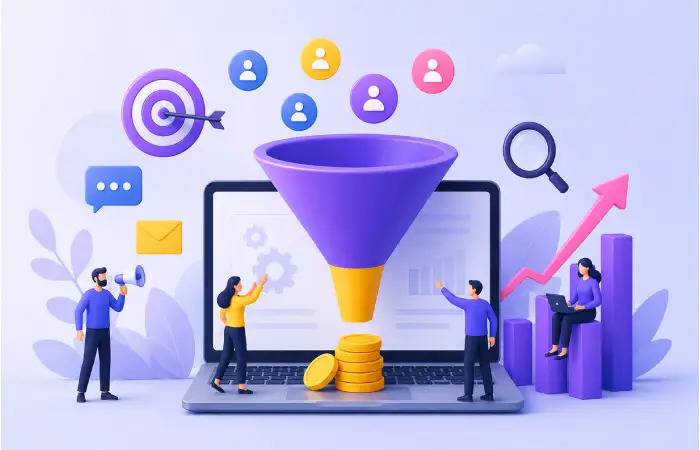
The act of taking a stranger and transforming them into someone who’s willing to pay for your software. In the realm of B2B SaaS, this often requires navigating through various stages including discovery, lead gen, product education, trial signing, demo request, onboarding, and eventually conversion.
With that in mind, SaaS customer acquisition needs to be built with recurring revenue in mind. You’re not just selling them an individual product; rather, they’re now entering into a relationship with your product, brand, and support team and your customer acquisition should never be the only goal.
A healthy acquisition process answers a few key questions:
- Who is the ultimate customer?
- What specific problem do they have?
- Where do they look for a fix?
- What message or offer forces a click?
- What’s the “cost to win” the click?
- Do they stick around to generate profit?
As a SaaS company, knowing these questions will also helps in growing the company smartly, making it cost effective for us
Customer Acquisition Cost
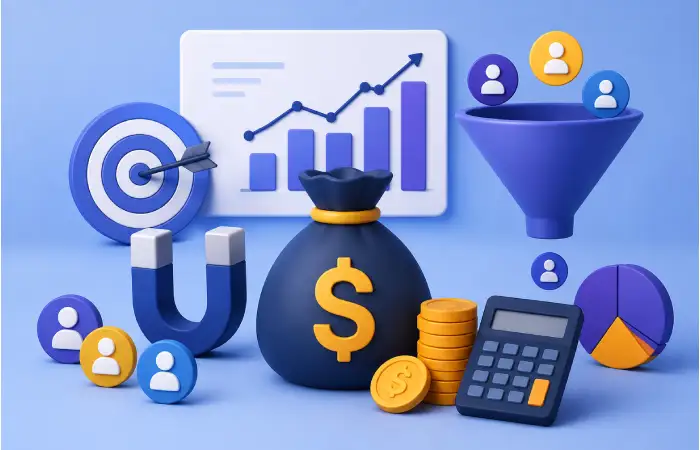
CAC(Customer Acquisition Cost) one of the key indicators of SaaS business. CAC is how much you spend to gain one paying customers.
The formula is simple:
CAC = Total sales and marketing spend / Number of new customers acquired
That sounds easy, but you’ll have to add more real-life expenses such as ads spend, content creation cost, software costs, Salaries costs,Agency cost,Sales Outreach Cost to that cost number. Without proper calculation and recording that will make your cost of customer acquisition seem more beautiful than it is.
Why CAC Matters
It’s fine to have a low CAC if those customers are quality, long-term customers who drive meaningful business. High CAC is fine if your LTV is sky-high, and your churn rates are flat or decreasing. The key isn’t just “How much does it cost to get a customer,” it’s “Was it worth it?”
| Metric | What It Tells You | Why It Matters |
| CAC | Cost to acquire one customer | Helps measure efficiency |
| LTV | Total revenue from a customer over time | Shows long-term value |
| CAC Payback Period | Time needed to recover acquisition cost | Helps manage cash flow |
| Conversion Rate | % of leads that become customers | Shows funnel quality |
| Churn Rate | % of customers lost | Impacts growth and profitability |
A SaaS business becomes much stronger when CAC stays under control and LTV grows steadily. In many cases, the best growth strategy is not “spend more,” but “spend smarter.”
Comparison Table: SaaS Acquisition Channels
Not every channel works the same way. Some are great for long-term growth. Some create quick traffic but weak conversions. Few are expensive but powerful for B2B buyers.
| Channel | Best For | Strengths | Weaknesses | Cost Level |
| SEO / Content Marketing | Long-term demand generation | Builds trust, compounding traffic, strong intent | Takes time to rank and mature | Low to Medium |
| Paid Ads | Fast lead generation | Quick testing, scalable, targeted | Can become expensive fast | High |
| Cold Outreach | B2B lead generation | Direct and personal | Requires strong messaging and good targeting | Low to Medium |
| Webinars / Events | Consideration-stage buyers | Builds authority and engagement | Needs planning and promotion | Medium |
| Referral Programs | Trust-based growth | High-quality leads, lower CAC | Depends on customer satisfaction | Low |
| Product-Led Growth | Self-serve SaaS | Easier to scale, lower friction | Needs strong onboarding and product clarity | Low to Medium |
| Partnerships | Shared audience growth | Credibility and reach | Harder to manage consistently | Low to Medium |
Most successful SaaS company has more than one channel. Depending on only one channel could be a bad investment. When this ad account suddenly stop working or when google search stop sending good traffic growth is at risk of slowing down fast.
SaaS Growth Tactics
Growth SaaS Strategy That Can Drive Acquisitions & conversions You need more than just visitors. You also need to motivate people to do something.
1. Build content around real buyer problems
Great SAAS content isn’t just features; it answer buyers questions, solutions to pain points and helps buyers to make better decisions. You need to be thinking in terms of use cases, buyer guides, comparison charts, workflows and use cases.
2. Offer a clear demo or trial path
Don’t Make Your Visitors Guess If you’re interested, make it crystal clear how they should proceed. Some visitors want a demo, others would prefer to try out a product or service first. Provide the most obvious next step.
3. Improve onboarding
Acquisition isn’t helping if people sign up then leave, and that’s why we love “onboarding” – quicker time to value, higher activation rates, more trial-to-paid conversion and better retention.
4. Use social proof
Studies, testimonials, logos, reviews and customer stories help allay some fears and reluctance. In B2B sales and acquisition, trust can be worth its weight in gold. People need to know they’re not buying snake oil.
5. Run focused experiments
Little adjustments for dramatic impact. Headlines, landing pages, CTAs, pricing pages, emails, lead magnets – test and iterate. Growth gets simpler when you use facts to drive your decisions, not opinions.
6. Align sales and marketing
In SaaS, acquisition works best when sales and marketing are aligned on the same communication principles and values. It should be up to marketing to bring in a well-qualified amount of interest. And for sales to be in a position to convert interest, they must do it with context and timing.
| Growth Tactic | Primary Goal | Best Stage of Funnel |
| SEO content | Attract organic demand | Awareness / Consideration |
| Paid ads | Drive targeted traffic | Awareness |
| Case studies | Build trust | Consideration |
| Free trial | Increase signups | Conversion |
| Onboarding emails | Improve activation | Post-signup |
| Retargeting | Recover interest | Consideration / Conversion |
A good growth strategy is not about doing everything. It is about doing the right things in the right order.
Software Customer Acquisition
The process of acquiring customers for software, in many ways, has some distinguishing features. Whereas, in case of tangible software product you are able to touch, feel and then purchase software is intangible. Therefore the value has to be understood via content, product demo or by reading testimonials.
That makes clarity extremely important. A good SaaS website must explain:
- What the product does
- Who it is for
- What problem it solves
- Why it is better than alternatives
- How fast users can get value
- What the pricing structure looks like
A software buyer is usually cautious. They might evaluate different solutions, see the product demo, get the team’s input, or get authorization from above. It’s also for this reason that buying a software takes longer than in other sectors.
A quick and smart software customer acquisition strategy is to remove barriers.
You can remove barriers with:
- Free trials
- Freemium plans
- Instant demos
- Transparent pricing
- Simple forms
- Fast-loading landing pages
- Clear feature comparisons
When the buying process feels easy, conversion rates usually improve.
B2B Customer Acquisition
Acquiring B2B clients is usually harder for another reason, too. Since there are usually multiple decision-makers involved (a founder, manager, procurement rep, or a department head might have to OK it). The marketing needs to touch on logic, risk, ROI, and reliability.
In B2B SaaS, the best acquisition strategies often include:
- Educational content
- LinkedIn outreach
- Email nurturing
- Webinars and workshops
- Product demos
- ROI calculators
- Industry-specific landing pages
- Customer case studies
B2B buyers often want to get to a level of certainty prior to making the leap. How product fit into their work-life How is reliable the supplier
So the goal is not just attention. The goal is confidence.
Strong B2B acquisition usually depends on three layers:
- Awareness – the buyer learns your brand exists
- Consideration – the buyer compares you with alternatives
- Decision – the buyer feels safe enough to choose you
If one layer is weak, the funnel breaks. That is why a good B2B SaaS team pays attention to every step, not just lead volume.
SaaS Growth Framework
A SaaS growth framework gives structure to acquisition. It keeps the team focused on the same priorities and stops growth from becoming chaotic.
Here is a simple framework that works well:
1. Define the ideal customer
Start with the customer. Consider the company size, their job, the pain they want to fix, their budget and the time sensitivity.
2. Choose the right acquisition channels
Do not chase every platform. Focus on the channels where your audience already pays attention.
3. Create a strong value proposition
Your message should explain why your product matters in one clear sentence. If the value is hard to explain, acquisition will be harder too.
4. Build conversion assets
This includes landing pages, demos, comparison pages, case studies, and onboarding flows.
5. Measure the right numbers
Track CAC, activation rate, trial-to-paid conversion, churn, and payback period.
6. Improve continuously
Growth is rarely a one-time win. The best SaaS teams keep testing, learning, and refining.
| Framework Step | What to Focus On | Output |
| Customer definition | Audience fit | Ideal customer profile |
| Channel selection | Reach and intent | Lead sources |
| Messaging | Clarity and relevance | Value proposition |
| Conversion design | Ease and trust | Landing pages and CTAs |
| Measurement | Efficiency | Growth metrics |
| Optimization | Learning and scaling | Better performance over time |
This framework keeps acquisition grounded. It turns growth from a guess into a system.
Final Thoughts
Best SaaS customer acquisition is built upon clear communication, reliability, and accountability. That’s the overarching aim – to grow sales effectively. The aim shouldn’t be solely to get a leads, it’s to acquire the proper customer in a rate that may sustain an organization at an acceptable price point.
Customer acquisition price CAC – although important for business – has to not be viewed in isolation.
With a look at lifetime value, quality of conversions, and retention, effective SaaS customer acquisition can be a profitable development method.