

Last Updated: June 23, 2026
That dream of a “smart home” is no longer just that – it’s reality. And it’s become so natural and seamlessly integrated into our lives it’s easy to take it for granted. From vocal commands that can change your house’s light settings to remotely managing your home’s thermostat from miles away or keeping watch on your doors -smart home features don’t just offer cool factor and novelty.
These devices bring the benefits of saved time, comfort and more control over your home in truly significant ways.
Smart homes rely on integrated technology that enable all your home devices to talk to each other (or you), to respond to preset rules and routines, or simply execute your instructions as they see fit. Instead of running through every light switch in your home, or keeping your windows latched throughout the day, a smart system handles these tasks – all with minimal effort on your part.
This helps take the everyday “and one”s out of your day and frees up your precious time. A smart home system – one that integrates the lighting, the locks, the security system and even home appliances – adds convenience and can simplify life for busy individuals and families
Table of Contents
Home Automation Systems
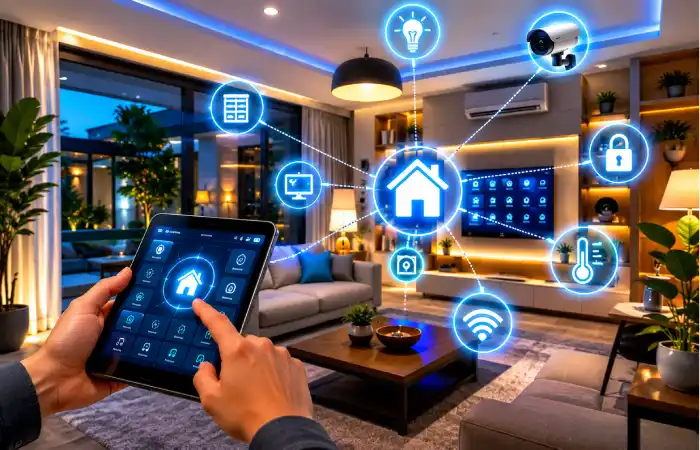
At the center of the smart home is a home automation system. Your devices and controls are consolidated here to make your home act on your behalf rather than on your command.
The most basic home automation setup would include things like smart lighting, thermostats, cameras, door locks, motion detectors and smart entertainment components.
Typically, these will integrate with a central mobile app or a smart speaker or dedicated smart home hub. From there they are either able to be scheduled, remotely operated or programmed to react to the environment.
For example, a home automation setup can:
- Switch on lights at sunset
- Lower the thermostat when you leave home
- Lock doors automatically at night
- Send an alert when unusual motion is detected
- Turn off appliances after a set time
The beauty of automation is the predictability. People forget things. Computers don’t. An automation system designed correctly reduces waste, error, and brings a degree of predictability back into our
Comparison Table: Types of Home Automation Systems
| Type of System | Main Purpose | Best For | Example Use |
| Lighting Automation | Controls lights automatically or remotely | Energy saving and convenience | Lights turn off when no movement is detected |
| Security Automation | Manages cameras, locks, and alarms | Safety and monitoring | Get an alert when the door opens |
| Climate Automation | Controls heating, cooling, and ventilation | Comfort and efficiency | Thermostat adjusts based on room use |
| Appliance Automation | Automates connected appliances | Daily convenience | Coffee machine starts in the morning |
| Whole-Home Automation | Connects multiple systems together | Full smart home experience | Lights, locks, and AC work in sync |
Smart Devices
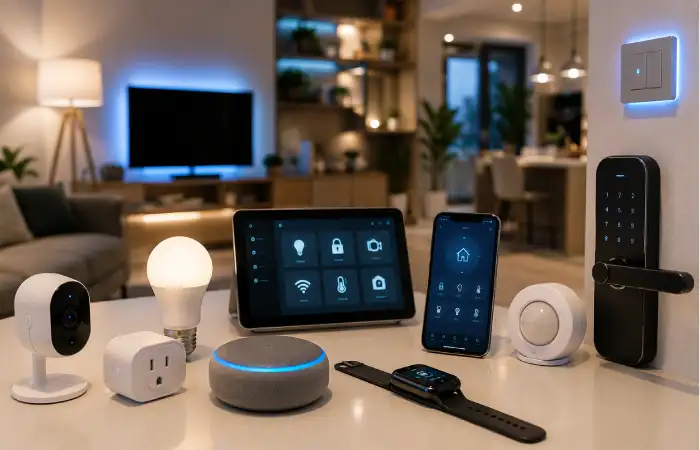
The products themselves that create a smart home are referred to as smart devices, or the most obvious portion that folks deal with a good deal. These take the form of several options but the key issue these devices possess is the fact that they are capable of connect by means of several options: 2.4-GHz Wi-Fi, Bluetooth, Zigbee, Z-wave or maybe by another smart house system.
Some of the most common smart devices include:
- Smart bulbs and switches
- Smart plugs
- Smart speakers
- Video doorbells
- Smart thermostats
- Smart TVs
- Smart security cameras
- Robot vacuums
- Smart appliances
Although individually they fix relatively minor problems, put them all together and they have quite an impact. A simple smart bulb can, as part of larger set, react to motion, respond to time of day or to a spoken command. A smart lock, while protecting your home, will also allow easy guest entry for non-keyholders.
Perhaps the biggest advantage to using smart tech devices is flexibility. Your smart home doesn’t need to be set in stone. Smart homes can start out small, with just a couple of devices and build up from there. This is one major reason why they have become so widespread, the technology doesn’t require you replace the entire home at once.
Smart Device Categories and Uses
| Smart Device Category | What It Does | Everyday Benefit |
| Smart Lighting | Adjusts brightness, hue, saturation, and flash pattern | Conserves your energy and lifts your mood |
| Smart Security | Watches for door entries and sends push noti | Helps ease worries and increase security |
| Smart Climate Control | Control Heating & Cooling | Helps maintain household comfort |
| Smart Entertainment | Connects TVs, speakers, and streaming | Makes media easier to control |
| Smart Appliances | Automates kitchen and cleaning tools | Reduces effort in daily chores |
The best type of smart device is going to make your life even simpler. There are no tricks here to make your home more of a chore to live in.
The goal is to make it work better for you.
IoT Home Technology
IoT home technology is the engine behind most smart home experiences. The internet of things or IoT refers to any tangible objects that are linked to the internet and can transmit information between devices. In our home setting, for instance, it means these products will gather information, transmit them and even react to them.
For instance, your smart thermostat learns when you’re most often at home, and programs itself to keep the temperature optimal during those times. Your smart camera sees motion and alerts you. Your smart fridge learns what your family consumes, to manage your inventory or notify you when you’re running out. They aren’t simply automated appliances – these devices utilize data.
IoT home technology works best when devices communicate with one another. That is where the “smart” part becomes more powerful. A motion sensor can trigger lights. A door sensor can activate a camera. A smoke detector can send a phone alert instantly. The more connected the system is, the more useful it becomes.
This also creates a better home experience in three major ways:
- Awareness: You know what is happening in your home even when you are away.
- Automation: Devices react on their own, reducing manual work.
- Adaptation: The system can improve based on patterns and usage.
Of course, IoT home technology also depends on good internet stability, strong security settings, and proper device setup. A smart home is only as reliable as the network behind it.
Connected Home Solutions
Connected home solutions are the platforms and ecosystems that bring different devices together. They are what turn separate gadgets into a coordinated home experience.
Most connected home solutions include:
- A mobile app for control
- A voice assistant or smart speaker
- A home hub or bridge
- Device integration across brands
- Routine and scene creation
A connected home solution helps different smart products communicate more smoothly. Without it, users may need separate apps for every device. That can get messy quickly. With a strong connected system, everything becomes simpler to manage.
Comparison Table: Connected Home Solution Features
| Feature | Why It Matters | User Benefit |
| Central App Control | One place to manage devices | Less confusion, easier control |
| Voice Commands | Hands-free operation | Faster, more natural interaction |
| Device Automation | Schedules and triggers actions | Saves time and effort |
| Remote Access | Control from anywhere | Useful for travel or work |
| Scene Creation | Groups actions together | Creates custom daily routines |
A well-designed connected home solution should feel seamless. You should not need to think about the system all the time. The best systems quietly support your routine in the background.
Smart Living Technology
Smart living is an overarching theme to it all. It’s about a home that operates with efficiency, convenience, and thoughtful space use. Think beyond a smart home hub; incorporate smart locks, smart lights, and even smart energy.
Or integrate health features that track your breathing or automate medication delivery to ailing elderly parents, and improve quality-of-life improvements, such as automatic alerts or house cleaning.
Smart living technology is important; because people expect homes to evolve. People expect comforts, yes but also desire to save money and reduce stress and make security easier.
Some clear advantages of smart living technology include:
- Better energy control
- Improved home safety
- Less repetitive manual work
- Easier home management
- More personalized living spaces
Your Smart Home Should Support How You live, Not Change Your Life Around Your Device- this is what being smart actually delivers.
Benefits of Smart Home Technology
Smart home technology offers practical benefits that people notice quickly.
| Benefit | How It Helps |
| Convenience | Handles small tasks automatically |
| Energy Savings | Reduces unnecessary power use |
| Security | Gives better visibility and alerts |
| Comfort | Creates a more responsive home environment |
| Time Saving | Cuts down repetitive manual work |
| Remote Control | Lets you manage your home from anywhere |
These benefits are not abstract. They show up in everyday moments. A light turns on when you walk in. A camera tells you who is at the door. The AC switches off after you leave. These little actions add up and make daily life feel easier.
Challenges to Keep in Mind
Smart homes are helpful, but they are not perfect. A balanced view matters.
Some common challenges include:
- Device compatibility issues
- Setup complexity for beginners
- Privacy and security concerns
- Dependence on internet connectivity
- Higher upfront costs for quality systems
Luckily, the majority of these can be avoided or handled with attention to detail. The brand, a secure password, timely firmware updates and assembling it bit by bit will help you greatly.
How to Start Building a Smart Home
The first steps are simple and uncomplicated. A smart speaker alone, or a handful of smart lights or one plug-in adapter can already transform daily life. After you’ve seen that smart technology can improve your daily rhythm, expanding your home system can easily be achieved.
A simple starting plan could look like this:
- Choose your main goal: comfort, security, energy savings, or convenience.
- Pick one platform or ecosystem.
- Add one or two devices first.
- Test how they fit into your daily habits.
- Expand only when the system feels useful.
That approach keeps the process practical and avoids unnecessary spending. A smart home works best when it grows naturally.
Final Thoughts
Smart technology is far more than adding smart gadgets or devices to the home. Instead, the best use of technology in homes around the world helps to create homes that adapt to life itself by making your world more organized, secure, and more enjoyable through home automation systems, smart devices, IoT home technology, smart solutions and connected smart living technologies. This evolution transforms technology that typically functions like equipment into seamless extensions of the living spaces that people inhabit.