

Last Updated: June 22, 2026
Computer Vision Applications – These days, a computer’s job is more than just processing data. Machines are used for analyzing images, detecting faces, identifying objects, and making decisions based on visual information. We call this exciting and growing branch of artificial intelligence Computer Vision.
Computer vision, also referred to as visual intelligence, is among the fastest-growing areas in AI, empowering technology to ‘see’.
It has become essential, powering everything from a smartphone’s face unlock feature to a self-driving car that needs to see its environment. Computer vision has opened the doors to smarter and automated solutions.
Organizations of all types – in industries from healthcare and retail to security and manufacturing – use these visual systems to boost accuracy and efficiency. Let’s dive into the various uses of computer vision, understand what powers it, the benefits it provides, and where the field is going.
Table of Contents
What is Computer Vision?

Computer vision is also a science that allows us to use our devices, be it computers, phones, or even a system or process, to understand, explain, and perceive what they “see” from photographs and motion pictures.
When a human looks into a mirror, it is through our eyeballs, eyes, and also our brain that our understanding of our surroundings (your face in the mirror, for instance) is processed with the same logic that allows us to decode computer vision.
Key Functions of Computer Vision
| Function | Description |
| Image Recognition | Recognizes the elements and contexts in visual images |
| Object Detection | Finds multiple objects within an image |
| Facial Recognition | Facial recognition and authentication |
| Image Segmentation | Segments an image into different sections |
| Motion Tracking | Videos can do track in movement |
| OCR Technology | Converts images of text into digital text |
This can allow machines to ‘see’ the world and intelligently choose what to do with it.
Why Computer Vision Matters Today
Visual data production day and night is huge. Huge masses of photos, video files, X-rays, surveillance recordings produced daily.
Computer vision helps organizations:
- Automate repetitive visual tasks
- Improve accuracy and consistency
- Reduce human error
- Enhance customer experiences
- Boost operational performance
- Empower decision-making in real time
Therefore, computer vision has become a foundation of numerous modern technologies enabled by AI.
Image Recognition Technology
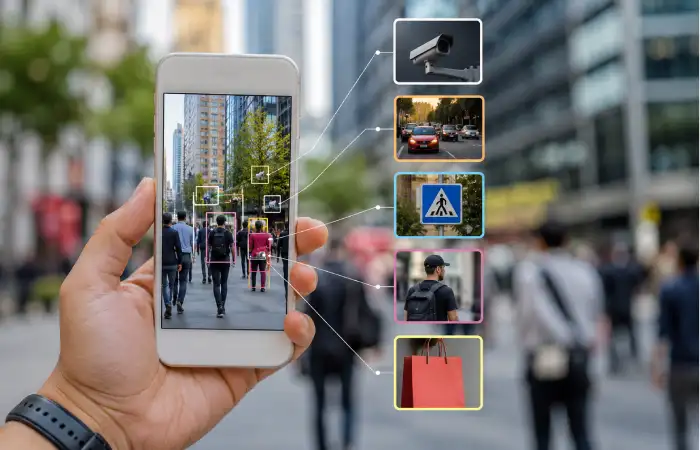
The best known use of computer vision technology Image recognition technology is probably the most common application.
The machine identifies objects like animals, people, places, products, brands, and companies on images in digital cameras, mobile devices and in documents.
How Image Recognition Works
The process typically involves:
- Capturing an image
- Processing image features
- Comparing patterns using AI models
- Classifying detected objects
- Producing accurate identification results
Real-World Examples
| Industry | Image Recognition Application |
| Retail | Product identification |
| Healthcare | Disease detection from scans |
| Agriculture | Crop health monitoring |
| Social Media | Automatic image tagging |
| Security | Suspicious object detection |
Benefits of Image Recognition
- Faster image processing
- Improved search capabilities
- Better inventory management
- Enhanced customer experiences
- Automated quality control
The deep learning algorithms that enable more sophisticated image recognition have learned this through exposure to vast training data consisting of millions of images.
AI Vision Systems
An AI vision system uses AI, artificial intelligence, to imbue machines with visual abilities.
In addition to image processing like most visual systems and traditional imaging programs, the AI will continuously develop through machine learning, as more and more data is fed into it.
Components of an AI Vision System
| Component | Purpose |
| Camera Sensors | Capture visual data |
| Edge Devices | Process images locally |
| AI Algorithms | Analyze patterns |
| Neural Networks | Learn from visual data |
| Cloud Platforms | Store and manage information |
Industries Using AI Vision Systems
Manufacturing
Factories use AI vision systems to inspect products and detect defects automatically.
Healthcare
Medical imaging systems identify abnormalities in X-rays, CT scans, and MRIs.
Transportation
Self-driving vehicles use AI vision to understand road conditions, traffic signs, and pedestrians.
Retail
Stores use AI-powered cameras to monitor inventory and customer behavior.
Advantages of AI Vision Systems
- Real-time analysis
- Continuous learning
- Reduced operational costs
- Higher accuracy
- Better scalability
AI-vision solutions empower enterprises to achieve new levels of efficiency in making visual decisions.
Facial Recognition Software
Face recognition is one of the most noticeable and discussed application of computer vision technologies.
It is the process for locating or establishing a person ID based on comparing facial features, from a video or picture with person records from existing face databases.
How Facial Recognition Works
The software typically:
- Detects a face
- Maps facial landmarks
- Extracts unique facial features
- Compares data with known profiles
- Confirms identity
Common Uses of Facial Recognition
| Application | Purpose |
| Smartphone Unlocking | User authentication |
| Airport Security | Identity verification |
| Banking | Fraud prevention |
| Law Enforcement | Criminal identification |
| Workplace Access | Employee verification |
Benefits
- Fast authentication
- Enhanced security
- Reduced fraud
- Contactless access control
- Improved user convenience
Challenges
Despite its benefits, facial recognition raises concerns regarding:
- Privacy
- Data security
- Bias in AI models
- Regulatory compliance
Organizations must ensure ethical and responsible implementation.
Machine Vision Applications
Machine vision systems is the application of computer vision. It is being deployed on industrial applications and manufacturing settings.
The main use of machine vision technology to ensure product inspection, process control and quality assurance standards.
How Machine Vision Works
These images can be acquired with industrial cameras and then analyzed with image processing algorithms.
Key Machine Vision Applications
Quality Inspection
Products are automatically checked for defects.
Assembly Verification
Ensures components are assembled correctly.
Packaging Inspection
Verifies labels, barcodes, and packaging quality.
Robotic Guidance
Helps robots perform precise manufacturing tasks.
Machine Vision Benefits
| Benefit | Impact |
| Faster Production | Increased efficiency |
| Reduced Defects | Higher quality products |
| Lower Costs | Less manual labor |
| Improved Safety | Fewer workplace accidents |
| Consistent Results | Reliable inspections |
Industries Using Machine Vision
- Automotive
- Electronics
- Food Processing
- Pharmaceuticals
- Aerospace
Machine vision becomes indispensable in the Industry 4.0 context and its implementations in modern smart factory settings.
Visual AI Technology
The technology powering the next frontier in computer vision is visual AI.
Through a sophisticated integration of advanced AI, deep learning, and computer vision the system becomes intelligent and interprets images and videos similar to how humans do.
What Makes Visual AI Different?
The standard form of computer vision identifies things.
Visual AI goes further by understanding:
- Context
- Relationships
- Activities
- Human behavior
- Environmental conditions
Visual AI Applications
Smart Cities
Monitoring Traffic and Congestion Management
Healthcare
Diagnosis of an ailment using a medical photo.
Retail Analytics
Get into customers’ habits.
Autonomous Vehicles
Real-time environment interpretation.
Security Monitoring
Intelligent surveillance and threat detection.
Benefits of Visual AI
| Benefit | Description |
| Predictive Analysis | Anticipates future events |
| Better Accuracy | Learns continuously |
| Real-Time Decisions | Faster responses |
| Enhanced Automation | Reduced manual intervention |
| Greater Insights | Deeper understanding of visual data |
Visual AI tech to underpin most future developments in various sectors.
Computer Vision Applications Across Industries
Healthcare
Computer vision can help doctors analyze scans.
Applications include:
- Cancer detection
- Tumor identification
- Retinal disease screening
- Surgical assistance
Retail
Retailers use computer vision for:
- Smart checkout systems
- Shelf monitoring
- Customer analytics
- Inventory tracking
Automotive
- Computer vision in self-driving car use cases:
- Lane detection
- Pedestrian recognition
- Traffic sign identification
- Collision avoidance
Agriculture
Farmers use computer vision for:
- Crop monitoring
- Pest detection
- Yield prediction
- Precision farming
Security and Surveillance
Applications include:
- Facial recognition
- Threat detection
- Access control
- Public safety monitoring
Computer Vision vs Traditional Image Processing
| Feature | Traditional Image Processing | Computer Vision |
| Intelligence | Rule-Based | AI-Based |
| Learning Ability | No | Yes |
| Accuracy | Moderate | High |
| Adaptability | Limited | Excellent |
| Real-Time Decisions | Limited | Advanced |
| Scalability | Low | High |
computer vision vastly outperforms most image recognition technologies in complicated environments.
Emerging Trends in Computer Vision
Several key trends define the future of computer vision:
Edge AI Vision
Processing visual data directly on devices instead of cloud servers.
3D Vision Systems
Providing depth perception for robotics and autonomous vehicles.
AI-Powered Video Analytics
Real-time monitoring and analysis of video streams.
Vision Transformers
Advanced AI architectures improving image understanding.
Generative AI Integration
Creating and enhancing visual content automatically.
These technologies will make computer vision more intelligent and efficient in the coming years.
Future of Computer Vision Applications
The computer vision landscape in the future looks great! With more compute power available and the growth of AI models, machine vision is going to enable new levels of understanding of what’s visual.
Future developments may include:
- Fully autonomous transportation
- AI-assisted medical diagnosis
- Smart manufacturing ecosystems
- Intelligent retail experiences
- Advanced robotics
- Enhanced augmented reality systems
Any business that begins integrating with computer vision now is simply going to gain a major step forward.
Conclusion
Computer Vision Applications What businesses and industries can Computer Vision Solutions help. The application of computer vision technology to understand the visual world around us with Image recognition technology, AI vision systems, Facial Recognition Software, Machine vision application, Visual AI technology etc.
Given that AI technology develops further in future years the role Computer Vision has to support automation, safety, healthcare, business, retail and traffic will grow exponentially. Those businesses will implement these technologies have the ability to streamline operations minimizing costs and providing brand new avenues for innovation.
FAQ
Q1. What are computer vision applications?
Applications of computer vision are those which use the intelligence of machine to examine images or the videos. Computer vision applications involve object detection, facial recognition, quality inspection etc.
Q2. How is computer vision being used in the healthcare industry?
These technologies are applied in a number of areas of the healthcare system, including analyzing medical images, diagnosing diseases, and aiding robots in surgery. Machine learning can also be applied to improve diagnosis of different type of diseases.
Q3. What is machine vision vs computer vision?
This involves the identification and classification of various features and objects for use in machine inspection processes, for example inspection in the manufacturing lines. Computer vision is a process, on the other hand, to identify what object can be called or defined, such as if we can describe to our robots to recognize that “What I’m looking is a human eye”, or “that could be dog”, etc.
Q4. Is facial recognition part of computer vision?
Face recognition system, one of the prominent computer vision applications. It allows a computer program to accurately identify whether a particular face is recognized and validated. Face detection can be used in several different places in computer systems and software in surveillance cameras in order to capture most of our identification.
Q5. What’s the future for computer vision?
Future trends for computer vision include autonomous vehicles, smart cities, healthcare industry utilizing powerful machine vision technologies, robotics, advanced visual intelligence, to achieve a high level of understanding and processing of any kind of environment around.