

Last Updated: June 11, 2026
How Artificial Intelligence is Transforming Everyday Life – AI has become far more than an issue for research and science fiction. Instead, it is now seamlessly incorporated within the devices you use daily. The artificial intelligence within it suggests your next song for you, filters unwanted junk email out of your inbox, and unlocks your mobile phone using your face as your security. But AI is also enabling doctors to analyze scan data, and suggesting what to buy online. For most, the sheer prevalence of artificial intelligence within daily life is a concept not truly noticed.
The importance of AI is not that it is able to “think” like humans. It is able to spot trends, make predictions and make intelligent suggestions far more rapidly. It’s why artificial intelligence is revolutionizing work, travel, shopping, communication, studying and the home. In essence, it is an unseen assistant, supporting a number of day-to-day tasks.
Table of Contents
What Is Artificial Intelligence in Everyday Life?

What is AI? AI stands for Artificial Intelligence. This is the term that represents a machine or computer program that can do things that human beings normally do. It is concerned with functions such as speech recognition, natural language understanding, object recognition, recommendation or prediction, and many others. In the real world, AI doesn’t necessarily look like a robot.
It often looks like smartness within an application, web service, search engine, car or device. And this is what is the reason why AI seems so natural now. AI works hidden from our sight and makes our daily lives easier, faster and sometimes more personal.
AI in simple words
Helps AI machines do three important things:
- Learn from data
- Recognize patterns
- Make decisions or suggestions
That is how AI allows the music app to know your preference, a bank to prevent fraud and a navigation app to predict the quickest way.
Comparison Table: Traditional Life vs AI-Powered Life
| Everyday Task | Traditional Way | AI-Powered Way |
| Searching information | Manual reading through many pages | Instant search results and smart answers |
| Watching movies or listening to music | Choose from limited options | Personalized recommendations |
| Customer support | Waiting for office hours | 24/7 chatbots and virtual assistants |
| Navigation | Using static maps | Real-time traffic updates and route prediction |
| Shopping | Browsing many products manually | Product suggestions based on behavior |
| Home management | Manual control of devices | Smart home automation |
| Healthcare support | Human review only | AI-assisted diagnosis and monitoring |
This comparison shows a clear shift: AI reduces effort, saves time, and improves convenience.
AI Applications
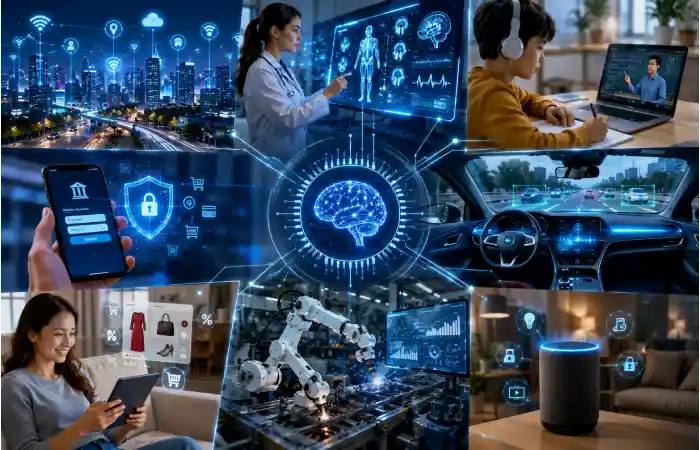
AI is now being used in most aspects of our day to day lives. Some of which are obvious and some we do not even notice are working.
1. Mobile Phones & Personal Assistants
AI can be seen working when you use the voice assistant feature, camera filters, keyboard predictions, facial recognition, smart suggestions on what apps to use etc. The phone that predict the next word you type is also AI. When your camera improves a night photo automatically, AI is helping there too.
2. Social media and content platforms
The AI in social media applications decides which updates, videos, and advertisements you see first. The AI in stream media applications selects material to show based on your tastes. The result for people, while perhaps a more dynamic experience, is that people tend to focus their time.
3. E-commerce and online purchasing
AI analyze your searches, buying trends and tastes in order to recommend what products might be interesting to you. AI can assist companies with pricing, inventory, and fake reviews detection. The benefits to consumers are quick product search. For sellers, there’s enhanced consumer segmentation.
4. Banking and finance
AI is used throughout banking in order to deal with fake identification, analyze creditworthiness, use chatbots and monitor transactions. It alerts consumers to suspicious account activity in seconds, thereby protecting from fraud.
5. Health care
Health care uses AI for examining images and scans, monitoring patients, making appointments, and providing health information by means of a chatbot. It allows the physician to quickly diagnose an illness based on scan information or patient notes.
Table: Common AI Applications in Daily Life
| Area | Example | Everyday Benefit |
| Communication | Email spam filters | Cleaner inbox |
| Shopping | Personalized product suggestions | Faster decisions |
| Health | Symptom checkers | Basic guidance and support |
| Finance | Fraud alerts | Better security |
| Entertainment | Streaming recommendations | Better user experience |
| Home | Smart thermostats | Energy savings |
| Travel | Traffic prediction | Shorter commute |
Artificial Intelligence Examples
We can gain better insights into the topic with some practical examples. It turns out that almost all of us use some form of AI on an everyday basis dozens of times a day!
AI examples people use every day
Search engines: The use of AI helps in understanding the context of what a user is really searching for.
Streaming platforms: The recommendations of what shows or movies to watch are driven by the AI’s knowledge of your watch history.
Map applications: AI helps in estimating traffic patterns to find the best route possible.
Email services: AI plays a key role in filtering emails based on identifying the spam and the questionable ones.
Shopping applications: It anticipates what the user might want to do in the next few seconds.
Voice Assistants: AI is essential in interpreting what you say and fulfilling those commands.
Social platforms: They use AI in ordering the feeds, filtering abusive content and increasing engagement on their websites.
Example in daily routine
Suppose the phone’s wake-up call recognizes your sleep patterns, the navigation app tells you how the traffic is, the email comes in through a spam filter, you order a breakfast you want from a food-delivery app that guess which one will be your favorite, and your music is playing in an appropriate tone. All of this is just part of the AI you use on a single morning by the time you are eating breakfast.
AI Technology Trends
AI isn’t standing still. It’s becoming more powerful, helpful, readily available and incorporated into everyday tools at an accelerating pace.
1. Generative AI
Arguably the biggest trending area in AI currently is generative AI, which allows for creation of content from text to images to code and more (as well as Summaries/etc). Applications range from assistance with writing, brainstorming, design to customer service.
2. AI in mobile devices
More sophisticated AI is becoming embedded directly in smartphones and computers-enabling faster response times, some improved privacy, and “smarter” experiences without necessarily relying entirely on cloud services.
3. Multimodal AI
Current AI systems are learning to combine and analyze input of different types, like text, images, audio, and video together. This leads to more practical and useful applications.
4. AI-powered search
From text-matching to conversational and context-driven answers, search is transforming. This makes finding information much quicker and more human like.
5. Edge AI
Edge AI processes data on or close to the device, instead of sending all data to a server. This makes the system faster, more private, and may be used for low latency, real-time applications, such as smart cameras and industrial sensors.
6. Responsible AI
The advancement and application of AI are spurring a significant effort to ensure fair, transparent, private and secure systems in order to counter bias and generate trust in these tools.
Table: Major AI Technology Trends
| Trend | What It Means | Why It Matters |
| Generative AI | Creates new content | Helps with writing, design, and coding |
| Multimodal AI | Understands multiple types of data | More human-like interaction |
| Edge AI | Runs near the device | Faster and more private |
| AI Search | Smarter information retrieval | Better answers, less effort |
| Responsible AI | Focus on ethics and fairness | Builds trust and safety |
AI Automation
One of the most useful forms of artificial intelligence used today is AI automation. Automation is the technology applied to some processes with or without human involvement. In integration of automation and artificial intelligence the system becomes intelligent and hence can adapt and improve with time.
How AI automation is beneficial
AI automation saves time and labor as well as enhances consistency of work performed. It is extremely effective for tasks which are routine, require lot of data, time-dependent or repetitive.
Examples of AI automation in the everyday world
Offices: it can sort e-mails, arrange meetings, compose reports, transfer inquiries to appropriate departments.
Homes: it can adjust lights, heating, cleaning equipment, and security.
In the commercial sector: inventory management, automated invoicing, customer responses.
Hospitals: records, patient alerts and appointment schedules.
Why automation matters
Automation eliminates labour – and that’s just the beginning. It frees people up to focus on high-value activities such as communication, problem solving, decision making and creativity. Consequently, it’s rapidly becoming implemented by households and organizations alike.
Table: AI Automation in Real Life
| Task | Without AI Automation | With AI Automation |
| Email sorting | Manual review | Auto-filtering and prioritization |
| Customer support | Human-only replies | Chatbot + human escalation |
| Home lighting | Manual switch control | Scheduled or sensor-based control |
| Meeting scheduling | Back-and-forth messages | Smart scheduling tools |
| Expense tracking | Manual entry | Auto-categorization |
| Security monitoring | Constant human watching | Smart alerts and detection |
Machine Learning Solutions
It is largely driven by machine learning. Machine learning is what allows AI to learn from instances rather than fixed rules. This is why it can be found in such a broad variety of tools we use daily.
What machine learning does
Machine learning is able to recognise the structure within data, enabling it to forecast and make decisions based on this. The more data, the better it can learn.
Common machine learning solutions
Recommendation systems enable streaming services, shops and news apps to suggest content you would be interested in.
The Fraud Detection Systems can learn your normal spending behavior and notify if the transaction is unlikely.
Speech Recognition will recognize spoken words in text and continuously improve the accuracy over time.
Image Recognition identifies persons, objects, animals or scenes in images.
Predictive Analytics has the potential to predict demand, behavior of customers or future threats
Why is machine learning important in everyday life
The strength of machine learning lies in the fact that it converts raw data into action. This translates to apps that are more capable, devices that react faster, and services that become more individualized. In fact, often, the end user does nothing at all-the system is just getting better.
Table: AI vs Machine Learning
| Topic | Artificial Intelligence | Machine Learning |
| Meaning | Broad field of making machines intelligent | A subset of AI focused on learning from data |
| Main goal | Simulate intelligent behavior | Improve predictions and decisions over time |
| Approach | Can include rules, logic, learning, and reasoning | Uses data and algorithms to learn patterns |
| Everyday example | Virtual assistants, smart devices | Recommendations, fraud detection, spam filters |
Conclusion
From phones to apps to how people drive, AI is now an essential and invisible part of our lives, used for purchases, entertainment and many other everyday tasks. AI is found in everything from AI applications and artificial intelligence examples to AI technology trends, AI automation and machine learning solutions.