

Last Updated: June 9, 2026
It‘s one of the most interesting times to be alive. The innovations of a new era of technology aren‘t just impacting the work that we do; they‘ve revolutionized the way that we live, communicate, and tackle complex issues. From artificial intelligence that can predict our demands to spaces that actually compute between the digital and the tangible, 2026 will be the year that emerging technologies graduate.
I‘ve been observing how technology has evolving for over ten years. What set this era apart from previous time is not the its speed of transition but its ‘harmonization’. Technologies that were developed in isolation are now integrated, and are bringing up opportunities that people would not even think were possible five years ago. It‘s resonating in your life whether you live in SF or Bangalore.
A new world is upon us. Technology defines today‘s generation and this document takes a close look at such defining technologies and how they are shaping tomorrow. From unpacking the hype and looking at real world execution issues, a pragmatic and pragmatic overview for US and India markets will be provided.
Table of Contents
What Defines New Era Technology?

New age technology: These are the groundbreaking inventions that revolutionize the way we communicate with information, machines and other people. They don‘t just add to existing capabilities; they open up new worlds of opportunity.
Key characteristics include:
Intelligence-first design. Systems that can learn and grow without direct intervention; they will be able to adapt and improve upon their own accord.
- Convergence ability: Technologies that complement one another.
- Humans related interfaces: Easy to use, need little training
- Cloud-native architecture: scalable, accessible infrastructure
- Real-time processing: data are being analyzed and responded to right away; no storage is needed
- Security-by-design: built-in security solutions as opposed to bolted-on features.
According to a recent report, emerging technology comprises 34% of a global $5.3 trillion dollars technology market in 2025. Technology adoption rates increased by 47% in USA and by 63% in India over previous year driven by adoption of mobile first technologies and digital payments infrastructure.
The difference-making factor is maturity. What was experimental in 2020 has become a unified, affordable, and widely available production tool.
Emerging Technologies Reshaping Our World
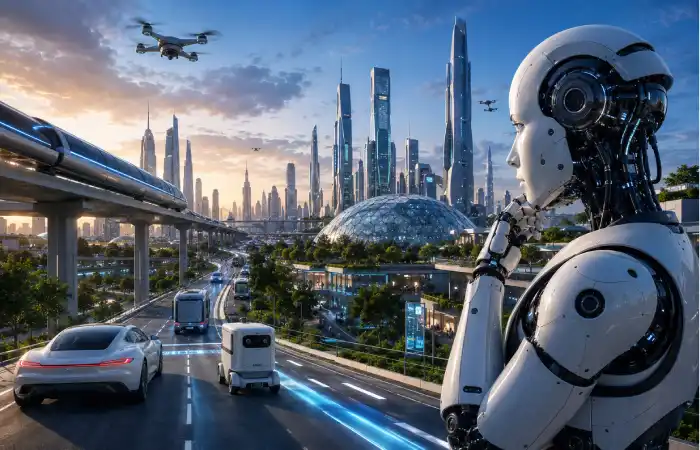
Emerging technologies can be defined as those technologies that have recently been turning from research to application. They are the ones Venture Capitalists are rushing to fund, companies are rushing to develop, and consumers are rushing to demand.
The most impactful emerging technologies in 2026:
Generative AI and Large Language Models
Generative AI crossed over from niche chatbots to a fundamental layer of business infrastructure. Organizations are writing code, hooking up AI to drive content creation across marketing, designing products, designing new drug compounds. Suddenly, industries were transformed by the quality of context and output from AI.In the US, 67% of Fortune 500 companies had embedded generative AI into their main operations by early 2026. In India, there was rapid adoption of AI-based language translation services, removing linguistic barriers between the 22 officially recognized Indian languages.
Quantum Computing Applications
Despite still being at very early stages, quantum computing also made a number of breakthroughs in 2026. Banks and other financial institutions were employing quantum algorithms to optimize investment portfolios while a number of pharmaceutical companies had made breakthroughs in drug discovery. Industries that relied of encryption developed quantum resistant variants.
None succeeded, but IBM, Google and India‘s C-DAC all managed “quantum advantage” for some tasks giving us a foothold in the world of practice.
Edge AI and Distributed Intelligence
Processing was moved from centralized data centers to edge devices such as your phone, vehicle, and household appliances. Your phone, vehicle, and home appliances now run complex AI models on device reducing latency, increasing privacy and working offline.
This transition was most crucial for India where patchy connection meant that edge computing was not just advantageous but vital.
Biotechnology and AI Convergence
Combining biology with artificial intelligence led to incredible breakthroughs. Now AI can even be used to forecast protein configurations, create bioengineered organisms and customize drug regimens to a particular patient‘s genome.
While the USA was leading the investment in biotech research. India became a manufacturing and clinical trial mecca for biotech products.
Main point: an emerging technology is such not just a single invention, but a network of like-minded innovations that extend each other‘s approaches. That‘s where the true magic begins artificial intelligence becomes quantum-powered, edge devices find a cloud-based intelligence, life sciences tap into the power of machine learning.
Practical implementation: Begin with one related to your most significant challenge. Learn, measure impact and grow to other tools.
New technologies are developing so fast. See how the world is changing by learning how artificial intelligence is changing your everyday life and learn about how real-world artificial intelligence is being used by consumers and businesses.
Future Technology Trends for 2026 and Beyond
If you have an idea of where the future of technology is heading, then you can make smarter investments now. These future technology trends will be a combination of what is occurring now with what people are likely to desire.
Dominant trends shaping 2026:
Ambient Computing
Technologies making themselves invisible. Gone are the days when we would explicitly give instructions to our machines, we now expect our environment to intuit what we need and behave accordingly. A house cools down before you get home. Your car detects your anxiety levels and chooses the fastest route. A desk anticipates your next move.
And this represents ‘a fundamental shift in human-technology interaction’.
Sustainable Technology
Designing for the environment. Technology now evolves due to environmental issues, data centers powered by renewables, devices are designed to last, not to be replaced (planned obsolescence), and AI decreases cities energy needs.
By 2026, 73% of USA technology buyers will take account of environmental impact when making purchasing decisions and India‘s government will have set a requirement for all technology infrastructure projects to report on their sustainability.
Decentralized Systems
Centralized systems are under more pressure than ever before. Blockchain systems, federated learning, and p2p networks provide alternatives that give users more power, privacy, and security.
India‘s United Payments Interface (UPI) gave an example of how users’ control and privacy can be maintained when a decentralized system is able to handle at least over 10 billion transactions every month.
Hyper-Personalization
Generic experiences are becoming a thing of the past. Artificial Intelligence-enabled systems now bring personalized content, products, and services to you, on mass. Whether it‘s your news feed, your shopping journey, your learning path, or your healthcare, it is tailored to you, your needs, and your circumstances.
Extended Reality (XR) Integration
The physical is perpetually being superimposed by the digital. Digital layers are placed onto the physical world in augmented reality, virtual reality displaces the physical, and remote interaction is enabled through mixed reality.
Trend comparison table:
| Trend | USA Adoption | India Adoption | Primary Driver | Maturity Timeline |
| Ambient Computing | 34% | 18% | Convenience | 2-3 years |
| Sustainable Tech | 56% | 42% | Regulation + Values | 1-2 years |
| Decentralization | 28% | 37% | Privacy Concerns | 3-5 years |
| Hyper-Personalization | 67% | 71% | User Expectations | Current |
| Extended Reality | 23% | 15% | Hardware Accessibility | 2-4 years |
Key takeaway: The right trends add more functionality to existing technology, not replace it; in fact, the trend should be an additional feature not a competition to where you should be putting your money.
Future trends blend into human experience. Learn about the foundation of spatial computing to see how the physical and digital worlds are coming together.
Next Generation Technology Innovations
Next generation technology-technology that is the form of what is available today that is considered the forefront of what is possible.
Autonomous Systems
While self-driving cars made headlines, intelligent systems are now running in warehouses, on farms, in clinics or even production studios. They can make complex decisions entirely independently of human input, continually learning and growing from each interaction.
By mid 2026, Waymo and Cruise had launch autonomous taxis in 15 US cities and India had introduce autonomous farm equipment boosting yields 23% in trials.
Neuromorphic Computing
Neural network based chips modeled after the human brain were commercialized. These chips are good at pattern matching, require a fraction of the power of standard chips, and allow for artificial intelligence abilities in portable devices with batteries.
Intel‘s Loihi 3 and IBM‘s NorthPole chips showed the potential of neuromorphic chips for a range of applications from drones to diagnostics.
Synthetic Data Generation
Machine learning with AI’s needs huge quantities of data. Regulations limiting access and demand resulting from lack of data introduced pinch points, however. Synthetic data–artificially produced data that simulate existing data–came to the rescue.
Today, firms have been able to train AIs on fictional data sharing the same statistical properties as real information but with no personally identifiable data. Amongst other benefits, its use fast-tracked AI innovation and provided additional privacy safeguards.
Programmable Matter
On-demand modify physical features of materials went from sci-fi to early reality. Shape-shifting interfaces, self-healing materials and natural adaptable structures showed promise in niche scenarios.
MIT‘s self-assembling structures and Stanford‘s programmable materials had the potential for construction, manufacturing, and even medical implants.
Brain-Computer Interfaces (BCI)
Began to make huge strides in brain-computer communication was very close to. Medical applications were able to give paralysis victims a means of controlling prosthetics and talking, while consumer applications gave a means of controlling devices entirely by thought.
Neuralink, synchronization and Cognixion from India showed better BCI capability but it is still some years away before it goes mainstream.
Major difference: Next generation does not stand for next year. Such things are available today however they require a dedicated team, a large amount of money or particular use cases to be implemented.
Implementation framework:
Here are a few other good questions:
- Is it relevant? Will this technology help you solve a problem that you really care about?
- Is it mature? Is this technology ready for production or in the experimental stage?
- What is the ROI? Will you be able to put numbers to the returns?
- Consider alternatives: Are simpler solutions available?
- Plan integration: How does it fit your existing infrastructure?
Next generation technologies require strategic consideration. Understand digital transformation strategies for frameworks that assess and deploy next gen technologies.
Digital Transformation Technologies
Digital transformation isn‘t technology. It‘s “reworking business processes, customer journeys and operational models to take full advantage of digital capabilities”. But particular technologies allow a transformation that was nigh on impossible before.
Core digital transformation technologies:
Cloud Computing Platforms
Cloud infrastructure is the enabler for digital transformation of today. Scaling of processing powers, global accessibility, pay as you use model opened up availability which was once limited to huge organizations.
AWS, Microsoft Azure, and Google Cloud lead the market in the USA. Cloud computing is prevalent across India, led by Tata Consultancy Services and Infosys. The MeghRaj project help the Indian government migrate to the cloud.
By 2026, businesses support multi cloud and the majority (94%) of enterprises’ workloads span across multiple cloud providers for efficiency, performance and resilience.
Application Programming Interface (APIs)
APIs can be defined as the cement that hold digital transformation together. It is the interface between each distinct system in order for them to talk to each other, send data, issues commands. The API economy where firms open up their abilities as services for others to incorporate revolutionized software development.
Payment systems, mapping services, authentication, communication tools and thousands of other capabilities are crunched together into new solutions by developers.
Low-Code/No-Code Platforms
A typical digital transformation bottleneck is that the demand for applications exceeds the supply of developers. Low-code platforms allow professional developers to work at higher productivity while no-code platforms allow non-technical business users to develop applications.
This democratization of development rapidly shortened transformation from years to months.
Internet of Things (IoT) Infrastructure
The interconnection of sensors, devices and systems means that valuable real-time information can be gathered about the physical world. For example, equipment health in manufacturing, movement of stock in retail stores, levels of traffic in and between cities, and vital signs of people in hospitals can all be monitored remotely.
Globally 75 billion IoT devices were present in 2026, of this India added 8.2 billion devices which was the fastest growing rate in world.
Data Analytics and Business Intelligence
Transformation requires knowledge. Today‘s analytics platform transform raw data into actionable insights through visualization, discoverd patterns, and predictive modeling.
Business intelligence platforms such as Tableau, Power BI, and Looker allowed power users to do advanced analysis easily, and Python-based platforms like Apache Spark gave data scientists the ability to crunch extremely large data sets.
Digital transformation maturity stages:
| Stage | Characteristics | Technology Focus | USA Companies | India Companies |
| Digital Skeptic | Paper-based, manual processes | Basic digitization | 3% | 12% |
| Digital Explorer | Some digital tools, disconnected systems | Department-level solutions | 15% | 31% |
| Digital Player | Integrated systems, digital-first thinking | Enterprise platforms | 47% | 38% |
| Digital Leader | Data-driven, automated, continuously evolving | AI, advanced analytics | 28% | 14% |
| Digital Disruptor | Technology as competitive advantage | Emerging tech integration | 7% | 5% |
Common transformation mistakes:
- Technology ready approach: Providing solutions before determining problems
- Underestimating change management. Paying attention to the system and neglecting the humanfactor.
- Big bang implementation: Trying to do too many things at once
- Failure to take data quality into account: Elaborating through unstable pieces of information
- Neglecting security: Considering cybersecurity as something that can be added in after the fact instead of a fundamental building block
Transformation success framework:
- What are clear business outcomes: Where exactly does the transformation improve things?
- Take a realistic view of current: Where are you really?
- Prioritize based on impact: What changes yield the highest benefit the earliest?
- Establish the basic infrastructure: Develop a data, cloud, and security environment
- Repeat, learn and expand: Do a small pilot, measure, replicate and expand the good parts
Digital transformation requires several field of technologies being integrated into integrated systems. Get to know the details of the technologies of Industry 4.0 for manufacturing and industrial transformation.
Advanced Technology Innovations
Emerging technolog technology innovations are bleeding-edge technology, software innovations which are highly complex by design, usually very costly and adopted by leading-edge innovators rather than mainstream users.
Quantum Networking
Whereas quantum computing is a new paradigm of computing, quantum networking applies quantum mechanics for communication that is impossible to break. It uses quantum key distribution to make stealing information detectable by mathematics.
China‘s quantum satellite network and Europe‘s quantum internet testbed proved long-distance quantum communications, and USA is still keeping its defense applications in secret.
Holographic Displays
Real 3D displays, without special glasses, made great strides. Medical imaging, engineering design, and telepresence all gained from the holographic visualization of rich spatial relationships that don’t exist on a flat screen.
Looking Glass Factory‘s holographic screens and the updated model of HoloLens by Microsoft demonstrated real-world implementation, however the price is to high for it to be introduced to the public.
Swarm Robotics
Rather than single sophisticated robots, swarms utilize many basic robots that operate together. We already see swarms on farms for diagnostic monitoring, in search and rescue situations, for environmental sensing and even for building.
Molecular Data Storage
DNA molecules enable storage densities unachievable with any conventional media. One gram of DNA can hold 215,000,000,000,000,000,000,000 bytes of information (45,000,000 DVDs). Microsoft and the University of Washington retrieved information stored in synthetic DNA for two weeks.
6G Network Development
However, where 5G is yet to be rolled out across the globe, the development of 6G is underway. 6G is expected to land around 2030 and promises 100x the speed of 5G, sub-millisecond latency and AI baked into the network.
Japan, China, USA, and South Korea are in front of the 6G investigation. Among others, concerned India‘s IIT (Indian Institute of Technology) Madras put in place a 6G investigation center in 2025.
Reality check: cutting-edge technology always goes through the “trough of disillusionment” initial hype, quick rejection, then application. Use it sceptically but with knowledge.
Evaluation criteria for advanced technologies:
- Technical maturity is it beyond laboratory proof-of-concept?
- Geotechnical feasibility: Is it economically feasible? Cost structure.
- Regulatory certainty: Has legal and compliance architecture been laid?
- Integration complexity: Will they integrate with the rest of the systems?
Skill availability: turn up the individuals who knows it? Advanced Technology require patience and perspectives. Companies should be watching rather than adopted until it becomes mature and reduce their cost.
Technology Innovations 2026: The Current State
So what was different about 2026 in the history of technology? In many cases many innovations simultaneously crossed the Rubicon of critical mass thereby generating synergies, which makes impact even greater.
Defining innovations of 2026:
AI Integration Everywhere
AI moved from having it being just a specialized skill to a ‘must-have’ skill. Every key software platform, device and service had AI bit in. The question changed from having AI or not to, “which is the most powerful way of applying AI?”.
Copilot from Microsoft on all of their office products, Google‘s AI-powered search and Adobe‘s generative AI tools are how the AI was infrastructure and not innovation.
Spatial Computing Mainstream Adoption
Apple, Meta and Samsung unveiled consumer FLAT, low-cost glasses/headsets that deliver spatial computing to the masses Apple Vision Pro, Meta Quest 4, and Samsung‘s XR headsets. Enterprise use cases in training, design, and remote collaboration delivered measurable value, driving adoption.
There was also a steady growth in the USA of the spatial computing market which in 2026 reached $47 billion, in India the market for spatial computing reached $8.3 billion mainly targeted towards education and industrial training applications.
Sustainable Technology Mandates
Environmental standards became mandatory from voluntary. Due to EU‘s Digital Product Passport requirement, USA‘s green standard for infrastructure and India‘s E-waste Management Rules, plants adopted by manufacturers became repairable, recyclable and energy efficient.
This change in regulation in fact altered the basic philosophy of design of technology.
Autonomous Vehicle Deployment
Autonomous vehicles will be available for limited commercial service in defined locations. Fully autonomous delivery robots, freight vehicles within warehouses and autonomous car- and ridesharing services were launched in dozens of cities and generated millions of rides per month.
Safer than human drivers in controlled environments but all situation autonomous vehicles were several years away.
Personalized Medicine
Genomic information processed through AI helped tailor therapies to individual genomics. Cancer treatments, cardiological procedures and even prevention were tailored according to the individual patient.
Via the USA has invested $12 billion in precision medicine programmes, and for the IBM India has resulted Genome India Project 10,000 diverse genomes genome sequenced.
2026 technology snapshot:
| Innovation | Global Market Size | USA Adoption Rate | India Adoption Rate | Primary Application |
| Generative AI | $124B | 67% | 43% | Content creation, coding |
| Spatial Computing | $67B | 34% | 18% | Enterprise training, gaming |
| Sustainable Tech | $310B | 56% | 42% | Infrastructure, manufacturing |
| Autonomous Vehicles | $89B | 12% | 4% | Logistics, ride-sharing |
| Personalized Medicine | $156B | 28% | 9% | Cancer treatment, prevention |
Market dynamics:
The USA maintain a technological advantage at research and early innovation, particularly in the fields of AI, quantum computing and biotechnology. India is catching up in application, customization and low-cost delivery.
India also experienced a sharp up-swing in its technology services, which jumped 14.2% to $245 billion of revenue in 2026. The nation‘s development of frugal innovation achieving the same functionality as a higher-priced product at a fraction of the cost further shaped technology development worldwide.
Investment trends:
Venture capital moved towards implementation; investors focused more on proven technology in the hands of a company addressing a real market need than on untapped innovation likely to lead to disruptive technology. This is yet another sign of maturing industry.
Knowing what innovations are underway can be helpful in foreseeing the future. Look into the use of computer vision and all the ways in which visual AI has grown common in every industry.
Disruptive Technologies Changing Industries
Disruption: means new technology so totally redefines industry economics that existing approaches become irrelevant. For example, true disruption does not use existing processes to enhance existing ways (e.g. faster, better); it makes the old processes irrelevant.
Most disruptive technologies in 2026:
Blockchain Beyond Cryptocurrency
Just as Bitcoin was making headlines, the real disruptive forces within blockchain applications appeared in the fields of supply chain management, digital identity and automation of contracts. With its imperishable records, distributed trust and automated contracts, common mediators disappeared wherever blockchain was applied.
Walmart‘s food traceability blockchain can trace products from farm to shelf and locate the source of contamination within seconds, taking weeks previously. Land registry blockchain projects in India brought down the rate of land registration fraud largely in pilot regions.
Additive Manufacturing (3D Printing)
3D printing has gone from simply being a prototyping method to being a way of production. Aerospace companies print titanium parts, health care systems produce made-to-order implants and even building companies print building components.
Mass customization, breaks the economics of manufacturing. Whereas traditionally the object was mass produced by a large factory, printers deployed closer to the customer produce one‘s chosen object.
CRISPR Gene Editing
Genetic code correction changed the landscape of agriculture, medicine, and biotech industry. Crops resistant to many diseases, functional gene therapies for incurable diseases, even laboratory made living machines all were feasible.
The ethical considerations still remain fraught but CRISPR‘s technological capacity to “rewrite” biology is disruption on a most fundamental level.
Renewable Energy + Storage
While costs for solar and wind had fallen below those of fossil fuels in most markets, adoption remained limited because of intermittency. However, improved battery technology and other means of storing energy (thermal, mechanical, hydrogen) had overcome the problem.
The energy world will change as the era of the conventional large-scale power generation gives way to localized renewable generation sources with local storage. It will impact not only utilities but also transportation, manufacturing industries, and even geopolitics.
Vertical Farming
LED-lit, hydroponic, automated indoor farms grow more product per square foot than traditional farms, while using 95% less water than conventional agriculture. Vertical farms are built within urban cities and close to consumers, avoiding transportation.
This technology disrupts farming by separating the food from the climate and location. Singapore & UAE have a lot of vertical farms in recent years to ensure food security without arable land.
Disruption assessment framework:
True disruption exhibits these characteristics:
- New economics of unit: Existing business models are no longer valid
- Democratizes participation: Includes actors that were previously outside of the ecosystem
- Generates new value networks: New supplier-customer relations develop
- Pushes legal boundaries: Operates outside of regulation, at least initially
- Meets with opposition: incumbent businesses do not readily cede territory
Myth vs. Fact: Disruptive Technology
| Myth | Fact |
| Disruption happens quickly | Most disruption takes 10-20 years from inception to dominance |
| Better technology always wins | Market adoption depends on economics, not just technical superiority |
| Incumbents can’t respond | Many established companies successfully adapt to disruption |
| Disruption destroys industries | It transforms them—often creating more value than existed before |
| Only startups disrupt | Established companies sometimes disrupt themselves or adjacent markets |
Preparing for disruption:
Organizations can’t prevent disruption, but they can prepare:
- Monitor the edges: watch for solutions in narrow/specialty markets
- Test frequently: look for emerging tech that may not be mature, but still relevant to explore
- Retain strategic agility: avoid making a deep bet on today’s best approach
- Foster a learning culture: build organizational capability to change
- Collaborate with disruptors: sometimes partnering is better than fighting
Technologies disrupt and winners and losers are established. Look into the application of AI automation to understand the disruption to traditional business processes.
Intelligent Technologies and AI Systems
Intelligent technology is defined as a system that gathers information about its environment, interprets the collected data, makes decisions, and adapts its operation without human assistance. Artificial intelligence is used to operate most intelligent technology, but in general, any system classified as intelligent can be considered an intelligent technology.
Categories of intelligent technologies:
Machine Learning Systems
Machine Learning algorithms learn from the data without being specifically programmed to do so. Examples are recommendation engines that suggest features you may find interesting, fraud detection algorithms catching suspicious bills, and predictive maintenance foreseeing that a piece of equipment might break down.
ML evolved from an academic curiosity to indispensable. Every industry including financial services, healthcare, retail, manufacturing, and just about anything else now relies on ML.
Natural Language Processing (NLP)
By 2026, we had solved how to understand and generate human language. Chatbots have conversations and dialogs with customers indistinguishable from people, translation services work in 100+ languages, document examination reveals insights from terabytes of textual information.
Google‘s LaMDA, OpenAI’ GPT models, and Anthropic‘s Claude prove language understanding that wins almost every practical Turing test.
Computer Vision Systems
Computers now interpret visual information better than humans in many situations. Medical imaging AI finds cancers that radiologists miss, quality control systems find defects in products, and facial recognition allows secure identification. Expanding into agriculture, retail and entertainment (crops for diseased detection, checkout, motion capture and effects).
Reinforcement Learning
Learning in supervised learning has to be trained from previous experience (labeled data). whereas 5.1 Reinforcement learning learns best from trial-and-error. It is more suitable if the result is not immediately obvious.
DeepMind‘s AlphaFold is a great example of how contributions to AI in science have benefited biological research and has been used to successfully predict the structures of proteins. Many successes of reinforcement learning include energy conservation in data centers, where it was used to optimize the cooling to reduce energy use by 40%, and to enhance traffic light timings in smart cities.
Multimodal AI
More sophisticated AI systems tend to take inputs from multiple modes at the same time, for example a text and a speech, an image and audio or sensor data and video, thus providing a more comprehensive understanding.
These other systems learn across modalities for example, they access a recipe, play a cooking video, and then adapt the instructions to your kitchen utensils and you personally.
Intelligent technology stack:
Most intelligent applications combine multiple technologies:
- Data layer: data collection, storing and preconditioning.
- Processing layer: Computation and model training
- Algorithm layer: ML/AI techniques which will be applied to the problem
- Application layer users.
- Feedback layer: Ongoing learning and development
Real-world implementation example:
A smart hospital deploys intelligent technologies across operations:
- Patient monitoring: Wearable sensors monitoring vital signs; ML algorithms detect abnormalities and message nurses.
- Diagnostic help: computer vision works on X-ray and MRI; NLP on patient‘s history
- Operatory optimization: schedule procedures to create the most efficient operation through reinforcement learning
- Administrative automation: NLP pulls data from documents; ML forecasts volume of patients
- AI will suggest treatment methods based on individual‘s genetics with the collaborative research database.
Common implementation challenges:
- Biased or unrepresentative data sources: leads to incorrect conclusions
- Explainability needs: some sectors are more regulated than others and need to know the reasons why an AI made a decision
- Integration complexity: old systems were not designed to work with AI.
- Skills shortage. Data scientists and ML engineers are (still) rare and costly.
- Ethical issues: Privacy, bias, and accountability questions are not clearly answered
Best practices for AI implementation:
- Start with high-quality data: Clean, representative datasets determine success
- Define clear success metrics: Specify what improvement looks like quantitatively
- Begin with narrow applications: Master specific use cases before expanding
- Maintain human oversight: Use AI to augment human decisions, not replace them entirely
- Monitor for drift: Model performance degrades as real-world conditions change
- Address bias proactively: Test for discriminatory outcomes across demographic groups
- Plan for explainability: Understand decision factors, especially in regulated contexts
Regional AI development differences:
USA is a clear leader in AI research, especially around core algorithms and LL models. Well-funded startups and tech giants (Google, MS, Meta, OpenAI) are driving the technological frontier.
India is innovative in AP development and low cost AP deployment. Indian firms began to focus and excelled on customizing APs to specific domains and rollouts at scale. That was something Indian IT services companies had a firm hold on.
The artificial intelligence development (albeit not within this geographical scope of this article) affects via competition and co-operation the two markets.
Intelligent Technologies- The Next Generation of Power. Unveil the future of intelligent gadgets to see the integration of AI into homes and personal devices
Future Digital Solutions
Future digital solutions meet upcoming challenges using technologies that are only being further developed at the moment but are starting to have a defined impact.
Metaverse Infrastructure
The vision of an always-on digital environment where all activity playing, working, socialising, building, buying and selling would take place became more tangible. Initially hyped on a false premise in 2021- 2022, the metaverse‘s ideas turned into reality.
Virtual offices allows remote teamwork with a sense of presence. Digital twins enable a full simulation of the factory, cities and even supply chains for testing and optimization. Virtual events can be designed to deliver experiences impossible in physical spaces.
While Meta, Microsoft, Unity and Epic Games created the buildings, India‘s start-ups developed the metaverse applications for education and also cultural preservation.
Web3 and Decentralized Applications
The second stage in the evolution of the internet is about ownership and control. Blockchain enabled applications change the paradigm, how creators earn money, users own their personal data and communities run the platforms.
Despite such skeptics, the basic principles of platforms such as decentralisation, tokenisation, ownership by the user, continue to influence design
Digital Identity Solutions
Broken identity systems lead to friction, security issues and privacy risks. The future provides each verifiable digital identity user precise control over what information they present to each service.
India‘s Aadhaar system illustrated the advantages and disadvantages of a national digital identity. The US National Strategy on Identity, using a federated approach, is more similar to the EU‘s digital wallet, designed to offer portable identity.
Climate Technology
Digital is also tackling environment issues. AI manages energy grids for renewables, sensor measures methane leaks, satellites are monitoring deforestation and carbon accounting platforms are keeping track of emissions across multi-tier supply chains.
The simultaneous convergence of the environment and the digital age fostered a swiftly expanding climate tech industry drawing in vast investments.
Quantum-Resistant Cryptography
Quantum computers undermine our existing encryption systems. In the future we will have post-quantum encryption a means of secure communication which may be attacked only by an adversary with a quantum computer.
NIST standardized post-quantum cryptographic algorithms in 2024, and migration is underway across critical infrastructure. This is a multi-year migration necessary for long-term security
Solution evaluation criteria:
When assessing future digital solutions:
- Problem clarity: Does it solve a real, significant problem?
- Technical feasibility: Has it moved beyond conceptual to functional?
- Economic model: Is there a sustainable path to profitability?
- Adoption pathway: Can it achieve critical mass despite network effects?
- Regulatory environment: Will regulations enable or prevent adoption?
- Timing: Is the market ready, or is this premature?
Investment approach:
Most organizations should:
- Watch: Monitor development through industry publications and pilot projects
- Experiment: Test small-scale implementations to develop understanding
- Prepare: Build foundational capabilities that support future adoption
- Wait: Delay major investment until maturity increases and risk decreases
Future digital solutions require balancing innovation and pragmatism. Learn about cloud computing and future infrastructure to understand the foundation enabling next-generation applications.
Modern Technology Advancements
Technology today is the state-of-the-art that we have today…and we know it to be proven, realizable and no longer surprising.
5G Network Deployment
The fifth-generation cellular networks deliver speeds ten to one hundred times faster, latency reduced by a factor of ten, and capacity able to connect many more devices at once. This infrastructure supports applications unreachable with any earlier networks.
5G Coverage in the USA was 87% of the population and coverage by 2026 and infrastrucure rollout in India was centered around cities and covered 62% of the population. The India coverage was also rolling out quickly.
WiFi 6E and WiFi 7
Wireless evolved to allow bandwidth hungry applications to flourish; WiFi 6E moved out to 6GHz spectrum and freed up some room, WiFi 7 (802.11be) doubled the speed again.
These improvements enable video conferencing, cloud gaming, AR/VR solutions and smart home ecosystems, which older WiFi iterations weren‘t designed to support.
Solid-State Battery Technology
Batteries improve so EVs can be used along with grid scale energy storage systems. Solid-state batteries will give us even higher energy density, faster charging time, safer, and longer-lasting batteries than Lithium-ions.
Many companies announced the production of solid state batteries. Among them, the commercialization of batteries was led by Toyota, QuantumScape, and Solid Power, etc.
Advanced Robotics
Robots have since moved from performing mundane, repetitive operation tasks to more complex and unpredictable environments. Cobots or collaborative robots now work safely side by side humans, autonomous mobile robots are used to transport in warehouses and hospitals, and humanoid robots displayed amazing manual dexterity.
Figure 01 unveiled by Figure AI, Optimus by Tesla, and though they are not presented here, the Spot and Is based by Boston Dynamics have all demonstrated remarkable potentials, but their general use is not yet broad enough.
Satellite Internet Constellations
Satellite networks in Low Earth Orbit deliver high bandwidth internet around the world, and in other locations where establishing the necessary land-based infrastructure is prohibitively expensive.
Starlink was far and away the leader with over 5,000 satellites inorbit and providing internet service to three million customers worldwide. Amazon‘s Project Kuiper and other satellite internet efforts in India broadened the competition for satellite internet services.
Adoption recommendations:
Modern technologies offer clear benefits with manageable risks:
- Evaluate infrastructure: Several developments will depend on supporting infrastructure (5G needs devices, WiFi 7 needs routers etc)
- Calculate ROI: Quantify benefits against implementation costs
- Plan migration: Develop transition timelines that minimize disruption
- Train teams: Ensure people understand how to leverage new capabilities
- Monitor evolution: Technologies continue improving; plan for ongoing upgrades
FREQUENTLY ASKED QUESTIONS
Q: What exactly qualifies as “new era technology” in 2026?
A: New era technology refers to innovations that fundamentally change how we interact with information, devices, and each other—not just incremental improvements. This includes artificial intelligence that learns and adapts, spatial computing that blends digital and physical worlds, Industry 4.0 manufacturing systems, advanced cloud infrastructure, intelligent automation, and sophisticated cybersecurity. What makes 2026 unique is that these technologies reached maturity simultaneously, creating synergies that amplify individual impact.
Q: Which emerging technology should businesses prioritize first?
A: Prioritize based on your biggest challenge, not technology hype. Customer experience improvements start with AI-powered personalization. For operational efficiency, explore intelligent automation. A data-driven decisions, implement advanced analytics. A remote collaboration, invest in cloud infrastructure and spatial computing. The right first step depends entirely on your specific context—industry, size, existing infrastructure, and strategic objectives. Start with one technology, master it, measure results, then expand.
Q: How do I avoid choosing technology that becomes obsolete quickly?
A: Focus on open standards and interoperable systems rather than proprietary solutions. Prioritize platforms with strong ecosystems and active development communities. Choose vendors with long-term viability and commitment to backward compatibility. Implement modular architecture that allows component replacement without complete system overhaul. Most importantly, build organizational learning capacity—your ability to adapt matters more than any specific technology choice.
Q: What’s the difference between artificial intelligence and machine learning?
A: Artificial intelligence (AI) is the broad concept of machines performing tasks that typically require human intelligence. Machine learning (ML) is a specific AI technique where systems learn from data without explicit programming. Think of AI as the goal (intelligent machines) and ML as the current primary method for achieving it. Deep learning is a subset of ML using neural networks with multiple layers. Generative AI is a recent ML approach that creates new content rather than just analyzing existing data.
Q: Is cloud computing secure enough for sensitive business data?
A: Major cloud providers (AWS, Azure, Google Cloud) typically offer stronger security than most organizations can implement independently. They employ specialized security teams, maintain compliance certifications, implement physical security, and update systems constantly.