
Last Updated: June 23, 2026
The safest, most effective strategy to win back those free users and retain those paid ones? SaaS email marketing. It’s not an email broadcast, it is an entire user journey from sign up, to on-boarding, to adoption, renewal, upsell, and retention.
The software business cannot succeed solely through traditional business model because as an application of knowledge to practical problems for software companies, emails is not only a medium of communication but it is a growth system itself, where your users learn about product, go fast and stay long.
As well, emails bring your company more and revenue without relying too much on the paid.
Table of Contents
Why SaaS Email Marketing Matters
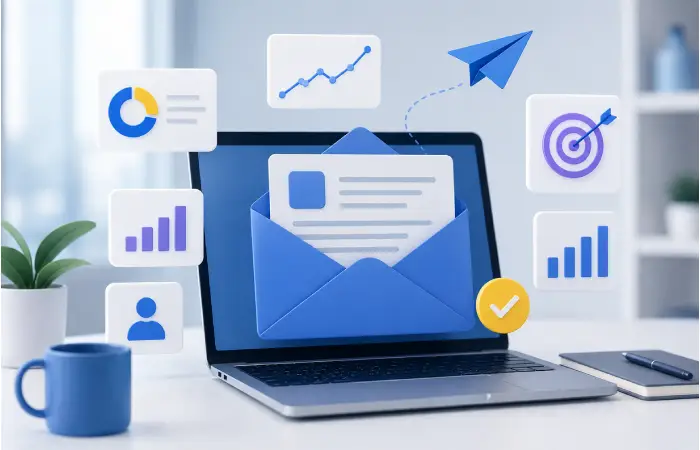
Most SaaS businesses, operate on a recurring revenue model. In that context, the function of every email has to extend beyond the opening and clicks. Every email you send to a user should help them make their relationship with the product progressive.
Here is why it matters so much:
| Benefit | Why It Matters for SaaS |
| Faster activation | Helps new users understand the product quickly |
| Better retention | Keeps users engaged after sign-up |
| Lower churn | Reminds users of value before they cancel |
| More upgrades | Encourages users to explore premium features |
| Stronger relationships | Builds trust through useful communication |
Customers of SaaS companies usually don’t buy after one email, though. Typically, it requires sending a bunch of micro communications at just the right time to make sure you’re answering all their questions and demonstrating value appropriately.
The Core Goal of SaaS Email Marketing
The main goal is simple: help users get value faster.
This can be different things to different products. To one piece of SaaS software, value is completing their first project. To another, it’s getting connected as a team, importing some data, getting their campaign started, or finishing off their first workflow. It helps if this feeling happens as soon as possible.
A strong SaaS email strategy usually supports these stages:
- Signup
- Onboarding
- Activation
- Engagement
- Retention
- Expansion
- Renewal
Each stage needs a different kind of email. That is where lifecycle marketing becomes powerful.
Lifecycle Marketing in SaaS
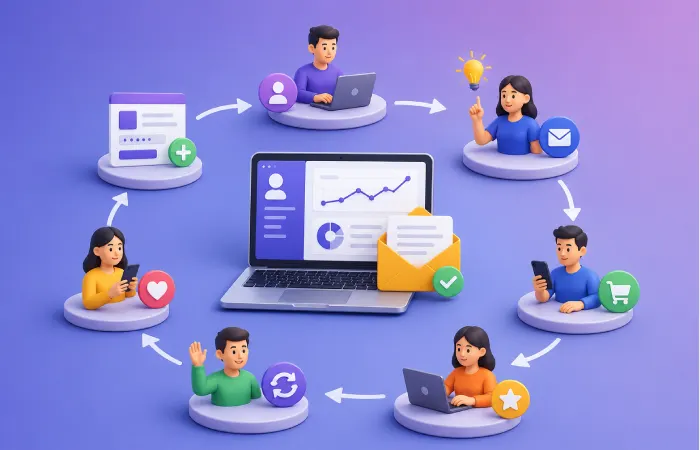
Lifecycle marketing is where we send emails according to which stage of the lifecycle you are. That’s where instead of blasting the same message to everybody, we send them message relevant to them at the relevant stage of the customer experience so it is not annoying. It feels helpful.
Common lifecycle stages
| Lifecycle Stage | Email Purpose | Example Message |
| New signup | Welcome and guide | “Here’s how to get started in 3 steps” |
| First-time user | Encourage activation | “Complete your first setup today” |
| Active user | Promote feature usage | “Try this feature to save time” |
| At-risk user | Re-engage | “You have not logged in lately” |
| Paying customer | Strengthen value | “Here’s how to get even more from your plan” |
| Renewal stage | Prevent churn | “Your subscription is coming up soon” |
Lifecycle marketing works well because the messaging feels very personal, not something generic the person is just being blasted with for the sake of marketing. Rather, he/she’s being served information relevant to the actions they have taken.
SaaS Email Automation
SaaS email automation makes lifecycle marketing possible by automatically sending an email based on user activity, time, and a trigger event. Use automation for: – Automated welcomes – Dunning emails to users who have not completed onboarding – A success email with a feature prompt once the first task has been completed … It all comes back down to save time and consistent outreach.
Useful SaaS automation examples
| Trigger | Automated Email Type | Purpose |
| New account created | Welcome email | Make a strong first impression |
| No login in 3 days | Reminder email | Bring the user back |
| Feature used for first time | Educational email | Show next step |
| Trial ending soon | Conversion email | Encourage upgrade |
| Payment failed | Recovery email | Prevent revenue loss |
| Inactive for 30 days | Re-engagement email | Win back attention |
The best automation flows feel natural. They do not overwhelm the user. They guide the user one step at a time.
Onboarding Email Sequence
The onboarding email sequence is one of the most important parts of SaaS email marketing. It helps new users understand the product and take action quickly.
A weak onboarding flow can confuse users. A strong one can dramatically improve activation rates.
A simple onboarding sequence structure
| Timing | Main Goal | Content Focus | |
| Email 1 | Immediately after signup | Welcome the user | Greeting, login details, next step |
| Email 2 | Day 1 | Help with first action | Setup guide, quick start tutorial |
| Email 3 | Day 3 | Build confidence | Common use case, feature benefits |
| Email 4 | Day 5 | Remove friction | FAQ, support links, short tips |
| Email 5 | Day 7 | Push activation | Reminder to complete important task |
What makes a good onboarding email?
A good onboarding email is clear, short, and action-focused. It should answer one main question: What should the user do next?
Use:
- One primary CTA
- Simple language
- Helpful screenshots or GIFs
- A single goal per email
- Friendly tone without sounding robotic
Onboarding is not the place to overload users with every product feature. It is the place to build confidence.
SaaS Retention Emails
SaaS retention emails keep people on board and prevent customers from leaving. It’s worth doing because it’s more cost-effective to retain an existing client than to win over new ones. Many SaaS retention emails don’t have anything to offer and the sender simply wishes to keep the customer alive as it’s more valuable than a new client.
Types of retention emails
| Type | Purpose | Example |
| Usage reminder | Bring users back | “You have unfinished work inside your dashboard” |
| Feature education | Increase adoption | “Try this feature to save time every week” |
| Milestone email | Celebrate progress | “You completed 10 projects this month” |
| Value recap | Reinforce ROI | “Here is what your team achieved” |
| Renewal reminder | Prevent cancellations | “Your plan renews soon” |
| Win-back email | Reactivate inactive users | “We have added new tools since your last visit” |
Retention email messages will succeed when tied to a user’s actions. If a user constantly doesn’t use a time-saving feature, consider an email highlighting a one compelling benefit of this feature.
Email Marketing for Software Companies
Email marketing for software companies is different from eCommerce or lifestyle brands. The buying cycle is longer. The product is more complex. The user often needs education before conversion.
That means your emails should do more than announce offers. They should explain value, reduce confusion, and support product use.
Best email types for software companies
| Email Type | Best Use Case | Why It Works |
| Welcome series | New signups | Sets the tone early |
| Product education | Active users | Improves feature adoption |
| Trial conversion emails | Free-to-paid users | Supports upgrade decisions |
| Customer success emails | Paying users | Shows the product’s value |
| Re-engagement emails | Inactive users | Helps reduce churn |
| Newsletter emails | All users | Builds trust and brand memory |
For software companies, emails often work best when they are personalized by behavior, plan type, industry, or usage level.
What a Strong SaaS Email Strategy Looks Like
A smart SaaS email strategy combines automation, timing, segmentation, and content clarity.
Here are the main ingredients:
1. Segment your audience
Not every user needs the same message. Separate users by:
- Free trial users
- Paying users
- Inactive users
- Power users
- Teams or enterprise accounts
2. Write for one goal at a time
Each email should focus on one action:
- Finish setup
- Try a feature
- Upgrade the plan
- Return to the app
3. Use behavior-based triggers
Behavior-based emails feel more relevant than generic blasts. If users opened an email but did not click, follow up differently than someone who never opened it at all.
4. Keep the message human
The best SaaS emails sound like they come from a helpful product expert, not a marketing machine.
5. Measure the right metrics
Do not stop at open rates. Watch:
- Activation rate
- Trial-to-paid conversion rate
- Feature adoption
- Retention rate
- Churn rate
- Revenue from email campaigns
SaaS Email Marketing Comparison Table
| Email Approach | Best For | Strength | Limitation |
| Broadcast emails | Company-wide announcements | Fast to send | Low personalization |
| Drip campaigns | New users and trials | Good for education | Needs planning |
| Behavior-based automation | Product-led growth | Highly relevant | Requires tracking setup |
| Lifecycle marketing | Long-term retention | Great for user journey | Needs strong segmentation |
| Retention email campaigns | Churn reduction | Improves loyalty | Works best with product data |
The strongest SaaS companies usually do not rely on one method alone. They combine all of them in a connected system.
Best Practices for Better Results
Here are a few practical rules that make a big difference:
- Keep subject lines clear and specific.
- Write short paragraphs for mobile readers.
- Use a single CTA in each email.
- Make every email feel useful.
- Personalize based on user behavior.
- Avoid sending too many emails too quickly.
- Test timing, copy, and CTA placement.
- Align email content with product usage patterns.
A great SaaS email does not feel like marketing first. It feels like help first.
Common Mistakes to Avoid
Many software companies hurt performance by making simple mistakes:
- Sending too many promotional emails
- Ignoring inactive users until it is too late
- Using the same message for every user
- Overcomplicating onboarding
- Writing generic copy with no product context
- Failing to connect email data with product data
These mistakes reduce trust and lower engagement. The goal is to keep the user moving forward, not to overwhelm them.
Final Thoughts
In SaaS email marketing, it needs to be personal, timely, and valuable – and it’s not just for clicks. It means driving user product adoption, retention, and continued value. Whether you’re orchestrating SaaS email automation, designing lifecycle marketing, crafting your onboarding email sequence, or strategizing on SaaS retention emails – your communications need to be framed by the product itself.